
Here at In Balance Green Consulting, we have received an influx of questions about fire-resistant assemblies for attics, particularly unvented attics. While this is a complex topic with many nuances, we’ll provide an overview of the options and what to look out for.
What’s this stemming from? Unvented attics have been a topic of roof assembly energy performance for a while due to the idea of creating a “conditioned attic” that can benefit the HVAC system and reduce heating and cooling loads. In addition, recent evidence from California wildfires has shown that high winds carry embers across residential areas, sometimes finding eave vent openings, which can contribute to causing the scattered ignition pattern of homes often seen.
Before we dive in to unvented assemblies, note that vented attics are still a code-compliant option. If using that approach, vents should be adequately screened to prevent embers from entering the structure. Screens at the ridge, eave, gable or roof plane should have openings 1/8” or smaller and/or vents should automatically close when fire is present.
Unvented Attics
For an unvented attic, the basic premise is that there are no openings and the assembly is air sealed to keep desired heating and cooling inside the home while blocking smoke and embers from coming in. An unvented attic, however, could end up with moisture issues and condensation if not appropriately mitigated, so the building code dictates how an unvented attic is to eliminate or greatly reduce the risk of moisture build up, depending on the type of insulation that is used.
Which brings us to an important material choice that dictates the rest of the assembly: Foam or No Foam.
Foam or No Foam
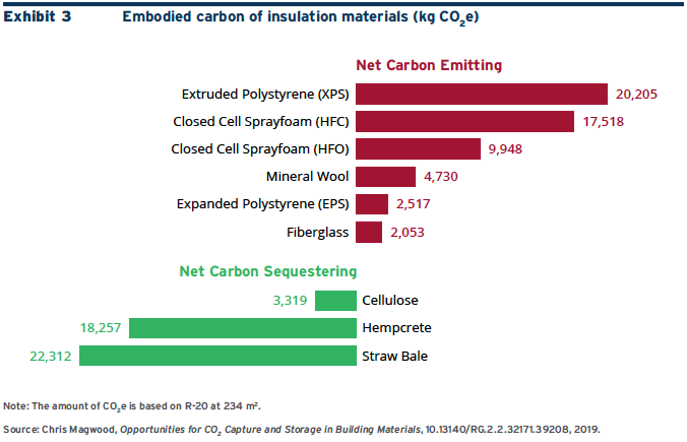
Many of the homeowners that reach out to us don’t want foam, because they are concerned about flammability if it does catch fire, and/or they are concerned about the environmental impacts of the foam itself.
For a foam assembly, it’s pretty straightforward: 2 inches of a closed-cell foam (“air impermeable”) on the underside of the roof sheathing serves as thermal insulation and as an air barrier, so vapor won’t build up and condense. Additional air-permeable insulation such as fiberglass batt or blown-in cellulose can be added to build up to the desired insulation level.
Non-foam Attic Assemblies
For a non-foam assembly, on the other hand, we don’t currently have a ‘pretty straightforward’ solution, but here is an approach being used to meet code and reduce the risk of moisture build up.
Using mineral wool insulation (e.g., Rockwool) as an example, we note it is air-permeable, and thus the code (and best practices) require that we have a way to eliminate unwanted moisture or vapor from collecting at the peaks of our attic. The issue is that moisture laden air or vapor can collect at the peaks and ridges, and during certain times of the year that moisture can condense on the underside of the roof sheathing causing the sheathing to degrade.
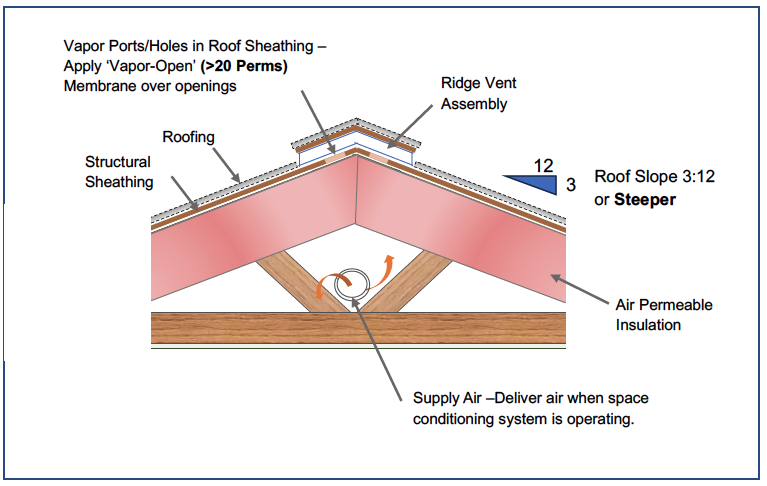
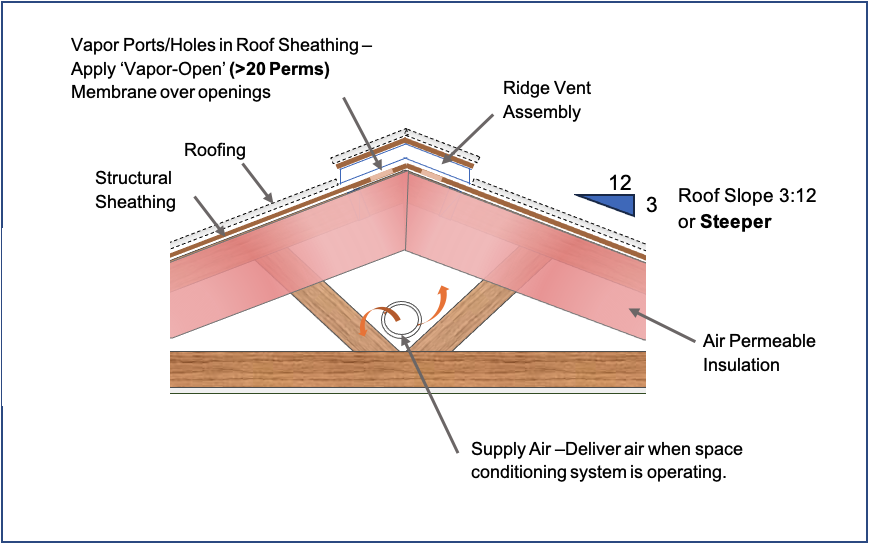
Conceptual Approach: Semi-Conditioned Un-Vented Attic with Vapor Diffusion Port at Roof Ridge
To address this concern, the current ICC and California residential building codes, specifically 2025 Residential Code Title 24 Part 2.5, R806.5, require vapor ports to be installed at the ridge or peaks of the roof for unvented attics with air-permeable insulation. The vapor ports can be detailed similar to ridge venting, but instead of having a direct opening into the attic via the ridge vent, the vapor port uses a “vapor open” (perm rating >20) product that covers or protects the opening. Vapor can escape, but heating and cooling stay in and embers stay out.
Another requirement in R806.5 is that unvented attic spaces be “semi-conditioned”; in other words, have a small supply duct from the HVAC system installed, thus helping to temper and dry the air in the attic. Specifically, 50 cfm per 1,000 SF of ceiling area should be supplied to the attic with the conditioning system.
Evolving Understanding
Building science and building codes are evolving in this area. For example, since the code was adopted, best practices and further research has shown that for many climate zones the code-required vapor port opening be at least doubled and in some humid climates doubled again.
Given California wildfire concerns and other environmental goals, we are seeing a new interest in unvented attic assemblies where homeowners do not want foam products. Our team continues to explore products and practices, working toward solutions that meet sometimes competing objectives.
We welcome your questions and feedback!